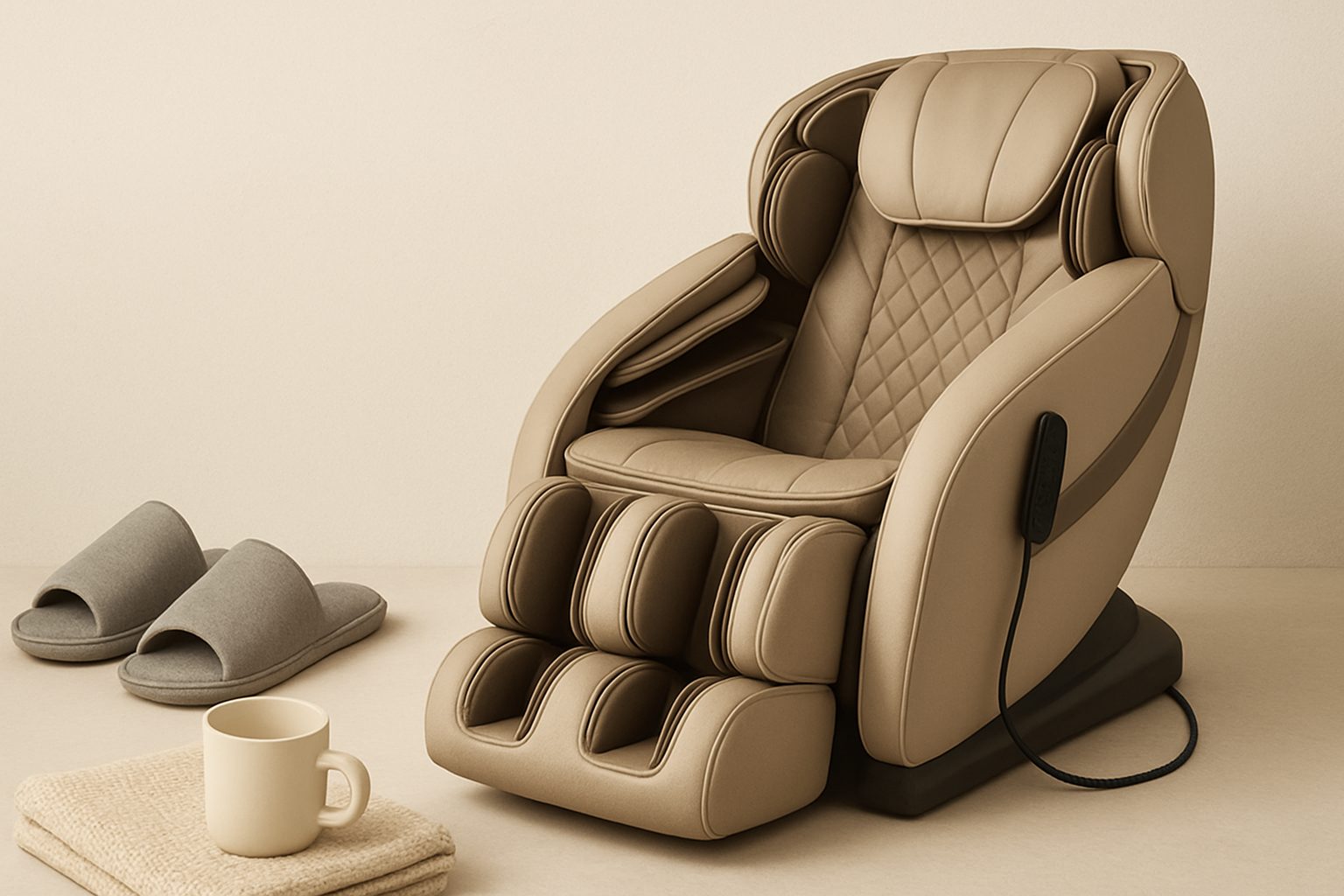
How to Choose a Massage Chair in the UK: The Complete Buyer's Guide
Investing in a massage chair is a significant purchase—prices range from under £1,000 to £10,000+, and you'll be looking at a substantial piece of furniture that'll occupy space in your home for years. Getting the right one means understanding what actually matters when you're sat in one, rather than just chasing brand names or feature checklists.
This guide walks through the practical decisions you need to make, what the jargon means, and how different specs translate to real-world comfort and longevity.
Track Types: Where the Massage Happens
The track is the spine of your massage chair. It defines how far the rollers and airbags can reach, and what movements they're capable of.
S-track follows the natural curve of your spine and typically stops at the lower back. You'll find these on entry-level chairs (£500–£2,000). They deliver solid neck-to-lower-back coverage but don't extend to the glutes or thighs.
L-track extends further, running from the neck down to the glutes and thighs. This is where you start getting massage coverage beyond the spine itself. Most mid-range chairs (£2,000–£5,000) use L-track. If you spend a lot of time seated and want glute or thigh relief, this is worth the jump.
SL-track and 2D/3D/4D tracks are marketing terms that essentially mean "L-track plus extra features"—usually referring to the intensity or width of the massage. Higher-end chairs (£5,000+) use these. The numbers (2D, 3D, 4D) refer to how many directions the rollers move: standard forward-backward, plus lateral, depth, or speed variants. In practice, a well-built L-track often delivers better results than a gimmicky 4D track on a budget frame.
The track you choose should match how much of your body aches. Neck and upper back pain? S-track is fine. Full lower-body tension? L-track or longer.
Roller Mechanisms: Speed, Width, and Feel
Rollers are what actually do the work. They vary significantly in how they perform.
Number of rollers ranges from 2 to 6 per side. More isn't always better—two precision rollers can outperform six mediocre ones. What matters is evenness and pressure consistency.
Speed and intensity should be adjustable. A chair that only pounds hard or only tickles lightly won't suit everyone. Look for at least 3–5 intensity levels, and ideally controls that let you adjust intensity per zone (neck separate from back, for instance).
Width matters too. Narrow rollers focus pressure on specific points; wider rollers spread it across bigger muscle groups. Better chairs let you switch between modes or have rollers that naturally adapt to your body width.
Shiatsu vs. kneading vs. tapping are common massage styles. Shiatsu mimics finger pressure and works well for deep tension. Kneading is gentler and good for recovery. Tapping is stimulating. You'll want a chair with at least two modes; premium models offer four or more.
Programmes: Do You Need Hundreds?
Entry-level chairs come with 5–10 pre-set programmes (a sequence of movements, intensities, and styles). Premium chairs advertise 50+ or even 100+ programmes.
Here's the honest bit: you'll use about three regularly. Most people cycle between "relax," "neck relief," and "lower back," and adjust intensity from there. Dozens of programmes mainly pad the marketing spec sheet.
What matters more:
- Can you customise and save your own programme?
- Can you run different intensities on different body zones simultaneously?
- Are the presets actually useful (not just "slow," "medium," "fast" in different names)?
Check whether the chair lets you pause, rewind, or adjust on the fly. A £3,000 chair with customisable control is better than a £4,000 chair with preset lock-in.
Body Scanning and Smart Mapping
Higher-end chairs (£4,000+) often include body-scan technology that detects your height and width, then automatically adjusts roller position and width.
This is genuinely useful if you're significantly taller or shorter than the "average" body the chair was designed for. It saves time and improves comfort distribution. However, it's not essential if you can manually adjust the tracks or move the chair to fit your frame. And it adds cost and repair complexity if it ever malfunctions.
For most people, a well-designed fixed track with manual intensity adjustment works just fine.
Dimensions: Will It Fit?
Massage chairs are big. Most are 70–80 cm wide and 110–130 cm deep. Recline extends another 20–30 cm forward.
Measure your space, including:
- Width in the room (accounting for doorway passage and side-to-side movement)
- Depth when fully reclined (don't assume it stops at the wall)
- Height clearance if your ceiling is low
Some chairs are designed for smaller spaces; Japanese brands often offer compact models. UK retailers should provide exact measurements—don't trust stock photos.
Weight Limits and Build Quality
Chairs typically support 100–150 kg. Check the spec for your weight range, and read reviews about frame durability, not just fabric.
Frame material matters more than you'd think. Steel frames outlast aluminium. Upholstery degrades, but the frame is what you're really buying. Look for reinforced corner joints and a heavy feel when you sit down—cheap frames flex noticeably.
Motor quality varies widely. A quieter motor (under 70 dB) is a genuine comfort feature; you'll be in a room with this thing for an hour or two per week. Noisy motors also suggest cheaper components overall.
What to Prioritise
- Track type matching your pain points (S, L, or longer)
- Intensity control that's actually adjustable and intuitive
- Physical fit to your space and body size
- Build quality (frame material, motor, joints)
- Trial period (30–60 days is standard in the UK)
Skip the gimmicks: 100 programmes, AI learning, heating that never works well anyway.
Next Steps
Once you've narrowed down the type (S-track vs. L-track, budget range, size constraints), you'll want to compare specific models. Read our detailed reviews to see how top-performing chairs actually perform in real homes, how long users find them useful, and where corners get cut at each price tier.
More options
- Amazon UK – Best Massage Chairs (General) (Amazon UK)
- Amazon UK – Zero Gravity Massage Chairs (Amazon UK)
- Amazon UK – Shiatsu Massage Chairs (Amazon UK)
- Amazon UK – Budget Massage Chairs Under £500 (Amazon UK)
- Amazon UK – Luxury & Premium Massage Chairs (Amazon UK)