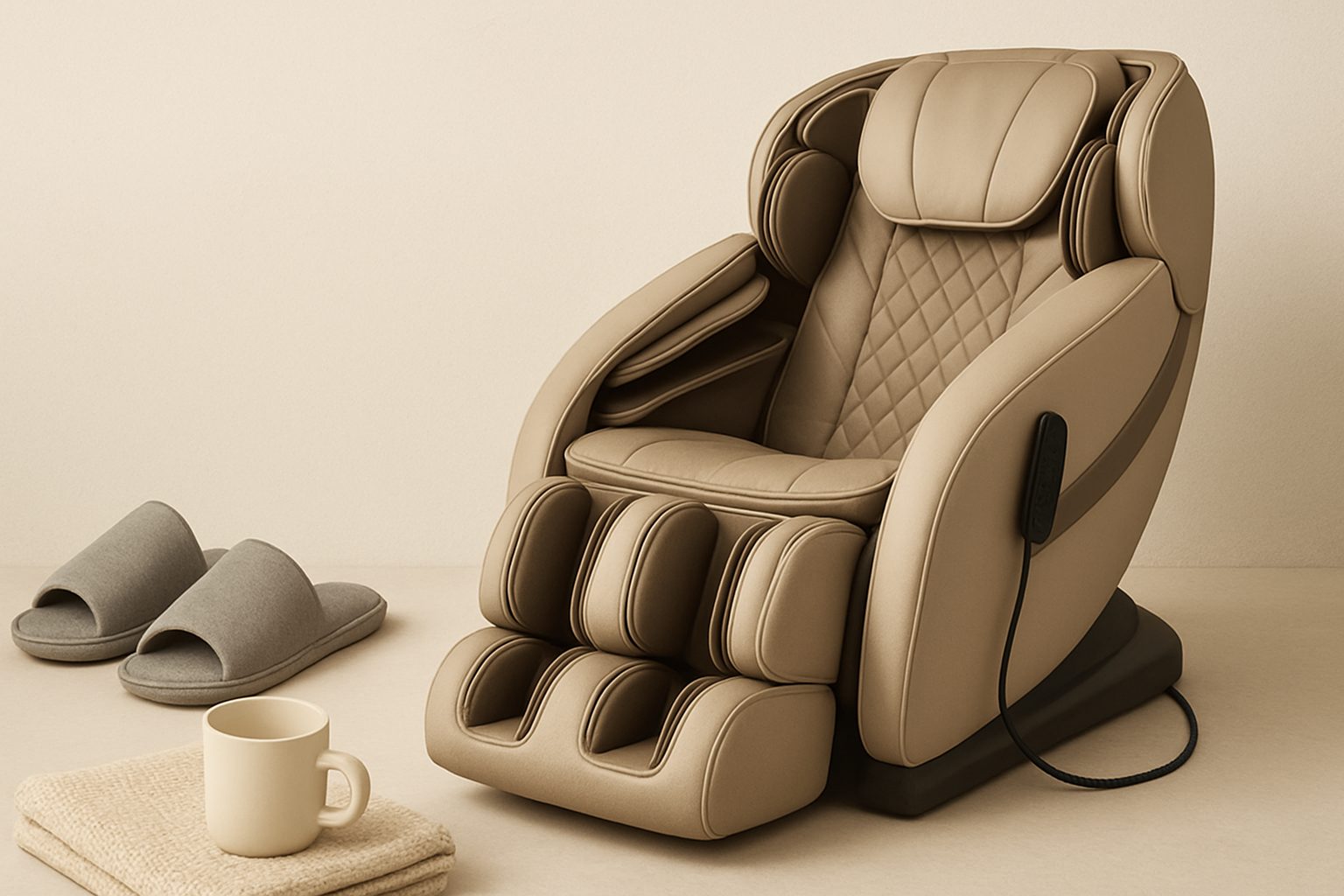
Best Full-Body Massage Chairs UK 2025: Head-to-Toe Relief Reviewed
A proper full-body massage chair should work your entire frame, from neck and shoulders down to calves and feet. The difference between a passable model and a genuinely useful one comes down to track design, motor strength, and how much of your body actually gets covered during a massage cycle. This guide explains what to look for and why those features matter.
Understanding Track Types: L-Track vs SL-Track
The rail system is where most of the action happens. This is what actually delivers the massage, so it's worth understanding the difference.
L-Track follows your spine from the base of your skull down to your lower back. It's the standard on mid-range chairs and does what it says—covers your full length. The massage heads move up and down in a straight line, which is fine for basic relief but misses your sides and doesn't wrap around your torso.
SL-Track (or extended L-track) adds an extra curve at the bottom. Instead of stopping at your lower back, it extends under your glutes and thighs. This matters if you spend long hours sitting, because it addresses tension that builds up in your hip flexors and the backs of your legs. Some high-end models have rails that arc outward slightly as they go down, which means the massage heads can reach the sides of your ribcage and your flanks—areas that standard L-tracks completely miss.
For genuine full-body coverage, SL-track is the better choice, though it does add cost. If you're mainly after neck and back relief, a quality L-track chair will do the job.
Shoulders and Upper Back: What "Kneading" Actually Does
Shoulder tension is what drives most chair purchases. A decent chair should have separate kneading motors in the shoulder region—these use a pressing and rolling motion, similar to what a massage therapist does with their palms and thumbs. It's not magic, but consistent kneading helps relax tight muscles and improve circulation in an area that bears a lot of stress.
Look for chairs where you can adjust the intensity and width of the shoulder massage. Cheap models use a one-size-fits-all approach, which either feels like a gentle buzz or an uncomfortable knocking. Better chairs let you dial in the pressure and choose between narrow (just the tops of your shoulders) and wide (across your upper back) coverage.
Some premium models add airbags to the shoulder section. These inflate and deflate rhythmically, creating a stretching sensation alongside the kneading. It's more effective than kneading alone, but also more expensive.
Calf Rollers and Foot Reflexology: The Overlooked Half
A lot of people focus on the back and forget that massage chairs can address your legs. Calf rollers—motorised drums in the footrest section—work your gastrocnemius and soleus muscles, which tighten up if you sit all day or exercise regularly. Quality matters here: heavy-duty rollers apply real pressure without feeling like a cheap vibration toy.
Foot reflexology is less about deep massage and more about stimulation. The footrest usually has nodes or rollers that press specific areas of your sole, with the idea that this can ease tension and promote relaxation elsewhere in your body. The science is mixed, but most people find it pleasant and it does help with general circulation.
When testing or buying, check that the calf and foot sections work independently of the upper-body massage. You might want to use just the foot section while working, without committing your whole body to a full cycle.
Heat and Vibration: Bonus Features That Actually Help
Lumbar heat (in the lower back region) is worth having. Warmth loosens muscles before the massage begins, making the kneading more effective. It's standard on mid-range and premium chairs and shouldn't be a dealbreaker if a cheaper model skips it, but it does improve the experience.
Vibration massage in the seat and backrest is common on cheaper chairs and less so on premium ones. There's a reason: it's less effective than air pressure or kneading for real muscle relief, though some people find the overall sensation pleasant. Don't pay extra for vibration if you can get kneading instead.
What to Consider Before Buying
Space and weight: A full-body massage chair is a permanent piece of furniture. Measure your space and check the chair's footprint when fully reclined. Most modern models are designed to sit close to a wall, but some need clearance behind them.
Noise level: Decent chairs run quiet; cheap ones can sound like a struggling vacuum. If you plan to use yours while watching TV or taking calls, this matters.
Reclining range: A chair that reclines fully flat is more comfortable for full-body massage, especially in the legs and feet. Limited recline (under 160 degrees) can feel cramped.
Preset vs. customisation: Entry-level chairs offer fixed massage programs. Mid-range and premium models let you adjust intensity, speed, and which body sections are active. Customisation is worth paying for if you'll use the chair regularly.
Warranty and support: Massage chairs have motors and moving parts. Check the warranty covers the mechanism, not just the upholstery, and that the retailer offers decent after-sales support.
The Honest Truth
A full-body massage chair won't replace a human therapist, and it won't fix chronic pain or serious muscle injury. What it does offer is consistent, on-demand relief for everyday tension—the kind that builds up from sitting, stress, or mild overuse. If you work from home or spend a lot of time at a desk, a good chair can genuinely reduce stiffness and help you relax at the end of the day.
The best full-body massage chairs balance track coverage (SL-track preferred), adjustable kneading motors, functional calf and foot sections, and a reasonable price. Avoid models that promise to "cure" anything or skimp on build quality in favour of extra features. A simple, well-built chair with strong motors will outperform a feature-laden cheap one every time.
More options
- Amazon UK – Best Massage Chairs (General) (Amazon UK)
- Amazon UK – Zero Gravity Massage Chairs (Amazon UK)
- Amazon UK – Shiatsu Massage Chairs (Amazon UK)
- Amazon UK – Budget Massage Chairs Under £500 (Amazon UK)
- Amazon UK – Luxury & Premium Massage Chairs (Amazon UK)